Country Balls: State Takeover
- 4.4
- Rating
- 1.00M
- Installs
- Free
- Price

 Analysis by App-foxy
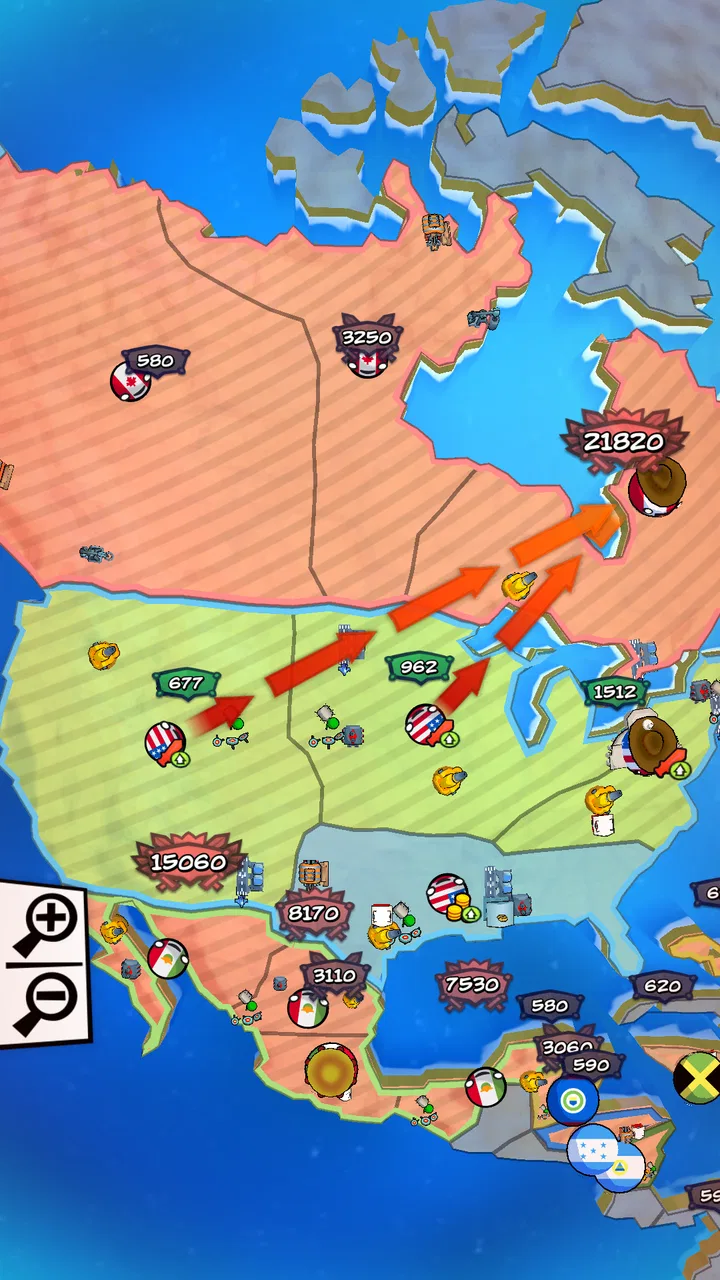
I approached Country Balls: State Takeover expecting a light strategy game built around the familiar countryball style, but the appeal is less about the joke itself and more about how quickly it turns a map into a series of decisions. You command a countryball, make choices around diplomacy and expansion, and try to turn a small position into a winning one. That basic idea is easy to understand, yet it leaves room for the kind of short planning sessions that work well on a phone.
This is a free strategy game from MAD PIXEL, rated Teen, and it has already passed one million installs. Its average rating sits at 4.4 from roughly thirteen thousand ratings, with hundreds of written reviews. Those figures suggest that the concept has found a substantial audience, although popularity alone does not tell you whether its pacing or spending model will suit you. After spending time with it, I see it as a casual conquest game with a playful presentation rather than a deep grand-strategy simulation.
How the takeover loop feels in practice
The strongest part of the experience is the constant tension between acting now and preparing for the next move. Expansion is tempting because it makes immediate progress visible, but a careless decision can leave you in a weaker position than before. I found myself treating every opportunity as a small calculation: is this the right moment to push forward, or should I first make my current position safer?
You May Also Like

 Blood Strike: 2.5 Anniversary
Blood Strike’s Loadouts Turn Every Drop Into a Tactical Gamble
A close look at Blood Strike’s custom loadouts: how fast access to signature weapons reshapes its battle royale rhythm, rewards preparation, and narrows the gap between fights.

 Pandora - Music & Podcasts
Pandora’s Music Is Easy to Start, but Harder to Recover
Pandora’s strength is its low-effort path from a seed to a station. Its weak spot is how much confidence it asks you to place in connection, setup, and quiet recovery.

 8 Ball Pool
 Is Built on Rivalries, Rematches, and Routine
A close look at the rivalries, rematches, shared routines, and unanswered safety questions that turn a quick pool match into a persistent mobile community.

 Samsung Music
’s Quiet Strength Is Playing What You Already Own
Its reach comes less from spectacle than from dependable access to a personal library. That simplicity is both the app’s strongest retention engine and its ceiling.

 AccuWeather: Weather Radar
AccuWeather Review: A Quick, Clear Forecast for Everyday Decisions
For everyday plans, the best forecast is the one you can understand quickly. AccuWeather makes rain timing, radar, and local conditions easy to act on, with a few trade-offs.

 Hill Climb Racing
Why Hill Climb Racing Still Turns Crashes Into One More Run
A tiny car, a bumpy hill and one more upgrade: Hill Climb Racing keeps resurfacing because its simple chaos makes every near-miss feel personal.
More From Our News Desk



That makes diplomacy more than a decorative word in the store summary. Even when the presentation stays approachable, the idea of negotiating before conquering gives the game a different rhythm from a simple tap-to-attack title. You are encouraged to think about timing, not only strength. A player who rushes through every available action may move quickly but lose control of the larger situation.
The countryball theme helps keep those decisions from feeling overly serious. The visual identity is humorous, recognizable, and much less intimidating than the dense maps and menus found in traditional strategy games. I would recommend it to someone who likes the idea of territorial planning but does not want to begin with a long tutorial or a complicated historical rulebook.
A good fit for short sessions
My most natural use case was a spare ten-minute window: waiting for an appointment, taking a break, or winding down before bed. The game gives that time a clear purpose because each session can revolve around a few decisions rather than a long commitment to a campaign. I could stop after making progress without feeling that I had abandoned an enormous simulation.
That convenience also creates one of its main limitations. Players who want detailed economics, layered military logistics, diplomacy with many possible outcomes, or a persistent world that demands long-term planning may find the experience too streamlined. Compared with established grand-strategy games, this is easier to pick up but less likely to satisfy someone who enjoys studying a complex system for hours.
It sits closer to a casual mobile strategy game than to a full desktop-style map simulator. That comparison matters because the game’s strengths are accessibility and quick decisions, not necessarily exhaustive control. If your preferred alternative is a deep strategy title with many interacting resources, this one may feel light. If your alternative is a basic arcade conquest game, the diplomatic framing gives you more to consider before tapping ahead.
Progress is satisfying, but pressure can change the mood
There is a pleasant sense of momentum in turning individual choices into a broader takeover. Early progress feels especially readable: you can see the direction of your plan and understand why a successful decision matters. I liked that the countryball presentation makes the map feel approachable while the strategy layer gives each move a purpose.
The pressure comes from the possibility that progress is not only about making correct decisions. In any free strategy game with optional purchases, the important question is whether spending feels like a convenience or a requirement. Here, purchases range from $0.99 to $20.99 per item. That is enough variation for players to think carefully before buying, particularly if they are unsure how much value a purchase adds to their own style of play.
I would not advise treating the in-app purchase menu as part of the core strategy. A better approach is to play long enough to understand the normal pace first. If the unassisted loop already feels enjoyable, an occasional purchase can be considered as an optional shortcut or support for the developer. If the game only becomes comfortable after spending, that is a sign to step back rather than chase progress.
Parents should also remember that the Teen rating makes this unsuitable for assuming a child-friendly experience simply because the artwork is cartoon-like. The countryball style is playful, but the age classification should guide family decisions. I would personally review the purchase settings before handing the device to a younger player, especially because individual items can cost noticeably more than a small impulse purchase.
Three practical ways to play more thoughtfully
My first useful habit was to separate expansion decisions from emotional reactions. A nearby opportunity can look attractive simply because it is available, but availability is not the same as value. I had better results when I paused and asked what that move would leave exposed. This is a small change, but it prevents the common mobile-game mistake of tapping through every highlighted option.
Second, I recommend using diplomacy as a planning tool rather than viewing it as a delay before conquest. If the game presents a choice between immediate pressure and a more measured approach, consider what you gain by waiting. The best move is not always the most aggressive one; sometimes the value is in preserving options for the next turn or decision point.
Third, keep a clear boundary around spending. Because the game is free to download and offers purchases across a broad price range, decide in advance whether you are playing without purchases, allowing only a small occasional amount, or treating optional spending as part of the entertainment budget. That decision is more useful than trying to judge every offer while already invested in a difficult moment.
These habits do not turn the game into a hardcore strategy simulator, nor do they reveal a hidden formula for winning. They simply make the experience less reactive. I found the game more enjoyable when I played it as a sequence of deliberate choices instead of a race to clear every available action.
Fairness depends on what you expect from competition
The question of competitive fairness needs a careful answer. The game is presented as a strategy experience, but the available information does not establish a detailed competitive structure, matchmaking model, or exact role for purchases. I therefore would not promise that spending has no effect on progression, and I would not claim that it determines every outcome. The responsible conclusion is narrower: optional purchases exist, and players should evaluate the game as a free title with monetization rather than as a completely purchase-free strategy environment.
For someone playing mainly against the game’s challenges, this may be acceptable. Many mobile players are comfortable paying for convenience when the underlying loop is enjoyable. For someone looking for a strictly even competitive contest, the uncertainty itself is important. I would choose a strategy game with clearly explained competitive rules if equal conditions between players were my highest priority.
This is also where the difference between “fair” and “comfortable” matters. A purchase can feel fair to one player if it saves time but uncomfortable to another if it seems to reduce the value of planning. I did not find it useful to assume that every offer was necessary. The safer reading is to enjoy the strategic decisions first and regard spending as optional until your own experience proves otherwise.
What I would check before committing
The game was released on February 22, 2025, and the current version is 2.1.2. It supports Android 7.0 and later, which makes it accessible to many older devices. Even so, compatibility is not the same as identical performance. If your phone is aging, I would test the game during a normal session before deciding whether it deserves permanent space on your device.
I would also pay attention to how the progression feels after the novelty of the countryball theme fades. The first sessions benefit from the simple visual hook, but long-term enjoyment depends on whether you like repeatedly weighing diplomacy, expansion, and risk. If you need a story-driven campaign with a strong cast, this is probably not the right choice. If you prefer a repeatable map-focused loop, it has a clearer reason to stay installed.
Another practical question is whether you want a strategy game that explains itself quickly. This title is more approachable than many serious map games, but accessibility can come with less detail. Players who enjoy discovering systems gradually may appreciate that. Players who want every rule, modifier, and consequence documented from the beginning may find the experience less satisfying than a more transparent traditional strategy game.
The Teen rating is another reason to consider your audience before installing. I would be comfortable recommending it to a teenager who already enjoys casual strategy and understands optional purchases, but I would not present the cartoon design as proof that it is aimed at young children. The rating and the purchase range deserve more attention than the cheerful artwork alone.
Who should play it, and who should skip it
I think this game is a good match for players who enjoy map-based decisions but want a lighter entry point. It works particularly well if you like countryball humor, prefer short mobile sessions, and enjoy deciding whether diplomacy or direct expansion is the smarter route. It can also suit someone returning to strategy games after a break, because the theme lowers the barrier to starting.
I would skip it if you are looking for a historically grounded simulation, a detailed multiplayer league, or a strategy game where every mechanic is explained with the depth of a manual. I would also be cautious if you dislike free-to-play pressure in principle. Even without assuming that purchases are required, their presence means the experience is not the same as buying a premium game once and receiving the complete system without further offers.
Compared with a premium strategy title, this one is easier to try and carries no upfront price, but it may ask you to make more judgments about pacing and optional spending. Compared with a simple puzzle or arcade game, it gives you more room to plan, yet it may demand more patience when a fast move does not produce the result you want. That middle ground is its identity, and it will appeal to some players more than either extreme.
My trust verdict after playing
My overall impression is positive but measured. MAD PIXEL has built a strategy game that communicates its central idea quickly: guide a countryball, use diplomacy intelligently, and pursue expansion without treating every decision as an automatic attack. The presentation makes the genre friendly, while the takeover loop gives the game enough structure to support repeated short sessions.
I also think the game is easier to recommend when expectations are set correctly. It is free, supports older Android versions, and has attracted a large audience, but those points do not make it a substitute for a deep grand-strategy experience. The Teen rating and optional purchases should be part of the installation decision, not details discovered only after a younger player or a budget-conscious user becomes invested.
My advice is to download it if you want a playful, accessible strategy game and are willing to judge the pace for yourself before spending. Start by learning how diplomacy and expansion interact, resist automatic moves, and decide your purchase limit in advance. If you want a serious competitive environment with fully transparent spending rules, choose a different strategy title. If you want a colorful mobile conquest game that gives you something meaningful to think about during a short break, Country Balls: State Takeover is worth trying.
FAQs for Country Balls: State Takeover
01What is the objective of Country Balls: State Takeover?
Country Balls: State Takeover is a strategy game where players use country balls to conquer territories and expand their empire. The main objective is to strategically deploy your resources, engage in battles, and outmaneuver opponents to take over the entire map. Players must manage resources efficiently and make strategic decisions to succeed.
02Is Country Balls: State Takeover free to play?
Yes, Country Balls: State Takeover is free to download and play. However, the game offers in-app purchases that can enhance the gameplay experience, such as special items, upgrades, or currency. Players can enjoy the game without purchases, but these options can provide advantages or speed up progress.
03What platforms is Country Balls: State Takeover available on?
Country Balls: State Takeover is available for both Android and iOS platforms. Users can download the game from Google Play Store for Android devices and the Apple App Store for iOS devices, providing a wide range of accessibility for mobile gamers on the most popular platforms.
04Does Country Balls: State Takeover require an internet connection?
While Country Balls: State Takeover can be played offline, certain features like leaderboards, social interactions, and updates require an internet connection. Playing online may enhance the experience by allowing access to these features, but the core gameplay is still accessible without internet connectivity.
05Are there any age restrictions for playing Country Balls: State Takeover?
Country Balls: State Takeover is generally suitable for players aged 9 and above. The game involves strategic planning and cartoon-style battles that are appropriate for a younger audience. However, due to in-app purchases and online interactions, parental guidance is recommended for younger players.
Pros
- Engaging strategy gameplay
- Colorful
- humorous graphics
- Easy to learn controls
- Frequent updates and events
- Interactive multiplayer mode
Cons
- Occasional connectivity issues
- In-app purchases can be costly
- Ads can be intrusive
- Requires stable internet connection
- Limited offline content

Country Balls: State Takeover
Gallery